Sri Mahalakshmi Thirunakshatram: Periya Piratti and Panguni Uthiram
In Sri Vaishnava tradition, Panguni Uthiram is one of the most tender and theologically rich observances of the year.
It is celebrated as the Thirunakshatram of Sri Mahalakshmi, revered in Sri Vaishnava tradition as Periya Piratti, the divine mother, compassionate mediator, and inseparable consort of Sriman Narayana. In the Srirangam tradition, this day is especially associated with Sri Ranganayaki Thayar, the divine consort of Sri Ranganatha / Periya Perumal.
For devotees, Panguni Uthiram is not only a festival. It is a day of grace, union, reconciliation, surrender, and family blessing.
It is the day when families remember that Sri Vaishnavism is centered not on Bhagavan alone in isolation, but on the Divya Dampati — Perumal and Thayar together. Sriman Narayana is always with Sri. The Lord’s justice, majesty, and sovereignty are inseparable from Thayar’s compassion, tenderness, and motherly intercession.
For Sri Vaishnava families living in India, the United States, Canada, the United Kingdom, Australia, Singapore, the Middle East, and beyond, Panguni Uthiram is a powerful day to teach children about Thayar’s grace, family harmony, humility, forgiveness, and the sacredness of married life rooted in dharma and devotion.
Editorial Accuracy Note
Sri Vaishnava practices vary by temple, family tradition, acharya sambandham, mutt, region, and panchangam. Panguni Uthiram is widely recognized in Sri Vaishnava tradition as the Thirunakshatram of Periya Piratti / Sri Mahalakshmi / Ranganayaki Thayar, and it is celebrated with special grandeur in Srirangam through the famous Serthi Sevai.
This article gives a family-friendly and devotional overview. For exact annual dates, rituals, fasting practices, seva schedules, and recitation order, families should follow their local temple, family acharya, mutt calendar, or panchangam.
What Is Panguni Uthiram?
Panguni is the final month of the Tamil calendar, usually falling around March–April. Uthiram is the nakshatra associated with this sacred observance.
In Sri Vaishnava tradition, Panguni Uthiram is especially important because it is associated with:
The Thirunakshatram of Sri Mahalakshmi / Periya Piratti
Ranganayaki Thayar of Srirangam
The divine togetherness of Perumal and Thayar
Serthi Sevai at Srirangam
The Pranaya Kalagam / Mattaiyadi utsavam tradition
The mediation of Nammalwar in the Srirangam festival narrative
The composition and recitation of Sri Ramanuja’s Gadyatrayam
Blessings for family harmony, marital grace, prosperity, and spiritual surrender
Panguni Uthiram should be understood not merely as a calendar day, but as a devotional teaching. It shows how Perumal and Thayar are approached together, how divine compassion softens judgment, and how reconciliation is part of sacred family life.
Who Is Periya Piratti?
Periya Piratti is a deeply affectionate Sri Vaishnava name for Sri Mahalakshmi, the divine consort of Sriman Narayana.
She is also revered as:
Sri Mahalakshmi
Sri Devi
Periya Piratti
Ranganayaki Thayar at Srirangam
Thayar, the divine mother
The compassionate mediator between the jiva and Bhagavan
In Sri Vaishnava theology, Thayar is not treated as separate from Perumal. She is inseparable from him. The very name Sriman Narayana means Narayana who is always with Sri.
Periya Piratti is the motherly presence who makes surrender approachable. When the jiva feels unqualified, afraid, weak, or burdened by karma, Thayar represents compassion. She does not reject. She recommends. She intercedes. She softens. She draws the soul toward Perumal.
This is why Sri Vaishnava families hold Thayar with such intimate affection. For children, she can be explained very simply:
Thayar is the divine mother who never gives up on us and helps us reach Perumal.
The Sri Vaishnava Meaning of Purushakaram
One of the most important theological ideas connected to Periya Piratti is purushakaram.
In simple terms, purushakaram means Thayar’s compassionate mediating role. She recommends the jiva to Bhagavan. She sees the faults of the soul, but she also sees the soul’s helplessness. She does not deny justice, but she brings mercy to the forefront.
A family-friendly explanation is:
Perumal is the supreme Lord. Thayar is the compassionate mother who speaks for the child.
In Sri Vaishnava life, this is not abstract theology. It shapes how families pray. Many devotees approach Perumal through Thayar because they trust her motherly grace.
This is why Panguni Uthiram is so important. It celebrates not only Sri Mahalakshmi’s Thirunakshatram, but also the truth that the path to Perumal is filled with Thayar’s compassion.

The Story of Sri Mahalakshmi’s Appearance
In many Hindu traditions, Sri Mahalakshmi is associated with the Ksheera Sagara, the ocean of milk. During the churning of the ocean, she appears with divine radiance, beauty, auspiciousness, and grace.
For Sri Vaishnava families, this story is not only about wealth or prosperity. It is about divine auspiciousness entering the world. Lakshmi is not reduced to material abundance. She is Sri — grace, compassion, auspiciousness, beauty, dignity, nourishment, and intercession.
On Panguni Uthiram, families may teach children:
Sri Mahalakshmi is the mother of the universe.
She is inseparable from Sriman Narayana.
She blesses families with auspiciousness, harmony, and devotion.
She helps the jiva approach Perumal.
Her presence makes the home gentle, graceful, and spiritually alive.
This is why families often associate Thayar worship with peace, prosperity, marriage harmony, children’s welfare, and household well-being.
Ranganayaki Thayar of Srirangam
At Srirangam, Sri Mahalakshmi is worshipped as Sri Ranganayaki Thayar, the divine consort of Sri Ranganatha.
Her name itself means the queen or beloved consort of Ranganatha. In Srirangam, she is not a secondary presence. She has a distinct and powerful role in the temple’s devotional life.
Ranganayaki Thayar is cherished as:
The mother of Srirangam
The compassionate protector of devotees
The divine consort of Periya Perumal
The one who receives prayers for family welfare
The one whose presence makes Perumal’s grace even more approachable
For many devotees, praying to Ranganayaki Thayar feels deeply personal. A mother does not wait for perfect words. She understands the heart.
Srirangam Sthala Connection: Periya Perumal and Periya Piratti
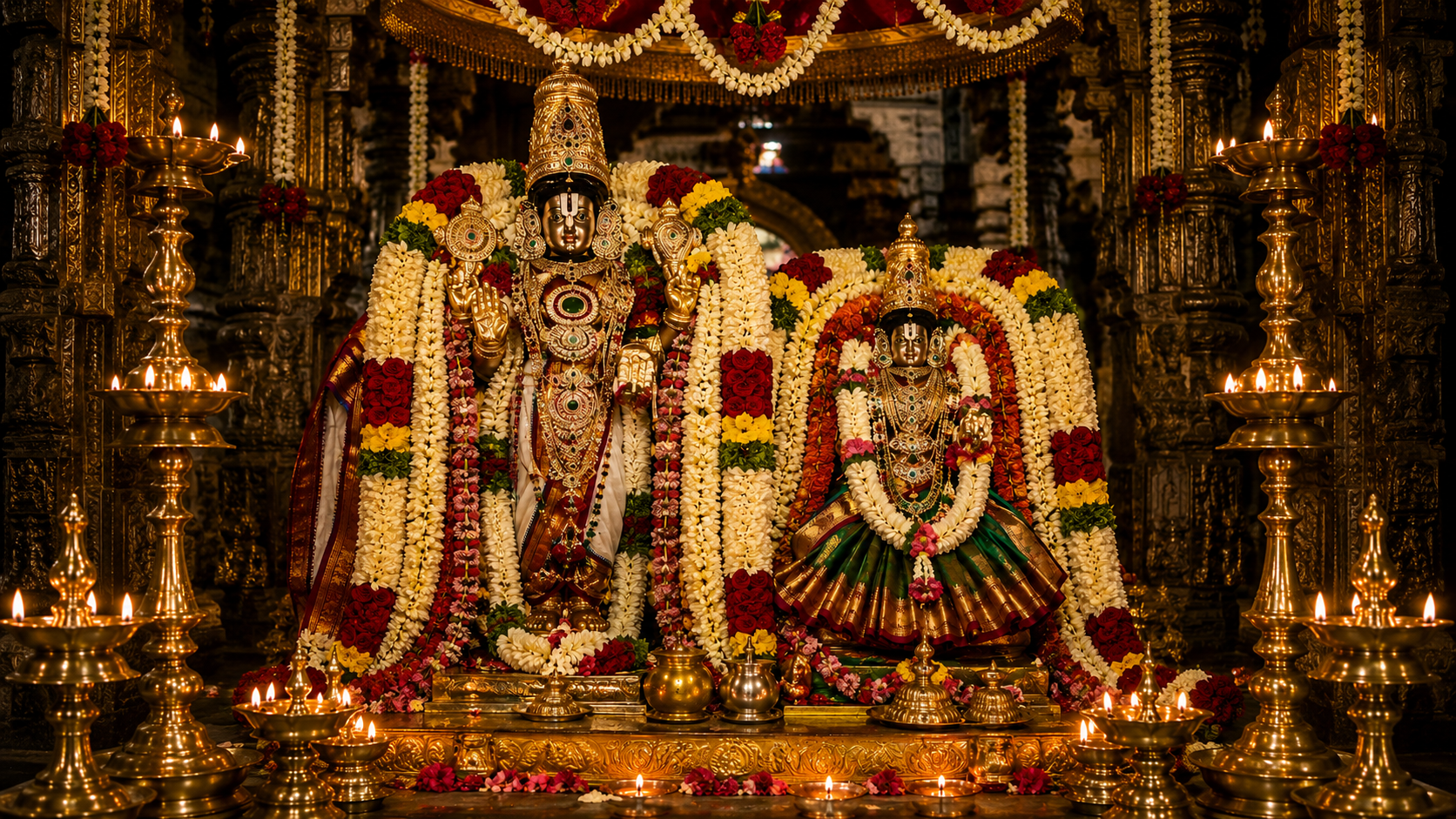
Srirangam is central to this observance because Panguni Uthiram is the day associated with the celebrated Serthi Sevai of Lord Ranganatha and Ranganayaki Thayar.
The word Serthi means togetherness. Sevai means darshan. Serthi Sevai therefore means the darshan of the Divya Dampati together.
This is one of the most beloved and emotionally powerful traditions of Srirangam.
For most of the year, Ranganayaki Thayar remains in her own sannidhi. On Panguni Uthiram, Namperumal comes to Thayar’s sannidhi, and the divine couple give darshan together in the Serthi Mandapam.
This is why devotees consider Panguni Uthiram to be a rare and sacred occasion. It is not only a public festival. It is a revelation of the Sri Vaishnava heart: Perumal and Thayar together are the refuge of the devotee.
The Panguni Uthiram Story at Srirangam: Pranaya Kalagam
One of the most beautiful and dramatic traditions connected to Panguni Uthiram at Srirangam is the Pranaya Kalagam, also known in some descriptions as Mattaiyadi Utsavam.
The story is presented through temple tradition as a divine, playful, loving disagreement between Namperumal and Ranganayaki Thayar.
In the Srirangam festival narrative, Namperumal has gone out, including the famed visit to Uraiyur Divya Desam, associated with Kamalavalli Nachiyar. When he returns to Ranganayaki Thayar, Thayar is displeased. The divine mother’s loving displeasure is expressed in the form of a dramatic debate.
Namperumal attempts to explain himself. Thayar is not immediately convinced. The temple tradition presents this as a divine version of emotional intimacy, not ordinary anger. It is pranaya rosham — loving displeasure between the divine couple.
Finally, Nammalwar mediates. Ranganayaki Thayar accepts Perumal again, and the divine couple grant Serthi Sevai together.
This tradition teaches several family values:
Even divine love includes expression, emotion, and reconciliation.
Mutual respect restores harmony.
A wise mediator can help resolve conflict.
Love is not the absence of disagreement; it is the ability to return to togetherness.
Thayar’s dignity and Perumal’s humility are both celebrated.
For SVMatrimony readers, this is a powerful cultural and marital lesson. A good marriage is not built by pretending conflict never happens. It is built by communication, humility, mediation when needed, and renewed togetherness.

The Visit to Uraiyur and Kamalavalli Nachiyar
A key part of the Srirangam Panguni festival tradition is Namperumal’s visit to Uraiyur Divya Desam, across the Kaveri, associated with Kamalavalli Nachiyar.
In the traditional festival narrative, this visit becomes part of the emotional setup for the Pranaya Kalagam between Namperumal and Ranganayaki Thayar. When Perumal returns, Thayar’s loving displeasure becomes the center of the festival drama.
This is not meant to be read as ordinary domestic conflict. It is sacred drama, or divine enactment, through which devotees experience the intimacy of Perumal and Thayar. Temple utsavams often teach theology through emotion, music, movement, debate, procession, and darshan.
In this case, the divine drama teaches:
Thayar’s supreme position and dignity
Perumal’s affectionate dependence on Thayar
The role of Nammalwar as mediator
The sweetness of reconciliation
The sacredness of Serthi Sevai
Nammalwar’s Role as Mediator
In the Srirangam Panguni Uthiram tradition, Nammalwar plays the role of mediator between Ranganatha and Ranganayaki Thayar.
This is deeply meaningful.
Nammalwar is the voice of the jiva longing for Perumal. His Thiruvaymozhi expresses surrender, separation, union, longing, and divine experience. In the festival narrative, it is fitting that Nammalwar mediates between Perumal and Thayar, because the Azhwar stands as the voice of devotional truth.
For families, this teaches the value of wise mediation. In life, conflicts may arise between spouses, siblings, parents, children, or families. A good mediator does not inflame the conflict. A good mediator restores perspective, dignity, and love.
Nammalwar’s mediation in the Panguni Uthiram tradition makes the festival a living lesson in reconciliation.
Ramanuja and the Gadyatrayam on Panguni Uthiram
Panguni Uthiram is also deeply connected with Sri Ramanuja.
Sri Vaishnava tradition remembers this day as the occasion when Ramanuja, beholding the Divya Dampati together at Srirangam, poured out the Gadyatrayam — three prose hymns of surrender and devotion:
Saranagati Gadyam
Sri Ranga Gadyam
Vaikunta Gadyam
These are not ordinary compositions. They are among the most treasured expressions of Sri Vaishnava surrender.
Saranagati Gadyam
This text presents Ramanuja’s direct surrender to the Divya Dampati. It is filled with humility, dependence, and longing for divine service.
Sri Ranga Gadyam
This is a direct prayer to Sri Ranganatha, full of devotion and the desire for eternal kainkaryam.
Vaikunta Gadyam
This gives a vision of Paramapadam, the divine realm, and the soul’s eternal service to Bhagavan.
For families, Gadyatrayam teaches that surrender is not weakness. It is the highest form of trust.
On Panguni Uthiram, Ramanuja’s example shows the Sri Vaishnava path clearly: approach Perumal through Thayar, with humility, longing, and confidence in divine grace.
The Taniyan for Periya Piratti / Sri Ranganayaki
A commonly recited taniyan associated with Periya Piratti / Sri Ranganayaki is:
nama: srIranga nAyakyai yath bhrO vibhrama bhEdhatha:
IsEsithavya vaishamya nimnOnnatham idham jagath
Simple meaning:
I bow to Sri Ranganayaki, by whose subtle glance the rise and fall, fortune and condition of the worlds are determined.
This verse captures Thayar’s supreme dignity and compassionate authority. Her glance is not ordinary. It is divine grace. Her favor uplifts. Her compassion protects. Her presence gives auspiciousness.
Families may recite this taniyan before offering flowers, lighting a lamp, beginning a Thayar-centered home observance, or teaching children about Panguni Uthiram.
As always, exact recitation practice may vary by acharya, temple, mutt, or family tradition.
Temple Rituals and Utsavams on Panguni Uthiram
Temple practices vary by Divya Desam and local tradition. In Srirangam, Panguni Uthiram is especially famous because of the Serthi Sevai of Ranganatha and Ranganayaki Thayar.
Commonly associated elements may include:
1. Thayar Thirunakshatram Observance
Panguni Uthiram is observed as Ranganayaki Thayar’s Thirunakshatram. Devotees offer prayers for family welfare, auspiciousness, peace, and marital harmony.
2. Namperumal’s Visit to Thayar Sannidhi
Namperumal comes to Ranganayaki Thayar’s sannidhi, creating the sacred occasion for Serthi Sevai.
3. Pranaya Kalagam / Mattaiyadi Tradition
The divine loving disagreement between Perumal and Thayar is enacted through temple tradition, culminating in reconciliation.
4. Nammalwar’s Mediation
Nammalwar is remembered as the mediator who helps bring the divine couple together.
5. Serthi Sevai
The Divya Dampati give darshan together. This is the emotional and devotional heart of the day.
6. Gadyatrayam Recitation
The Gadyatrayam of Sri Ramanuja is traditionally associated with Panguni Uthiram and is recited in many Sri Vaishnava settings.
7. Divya Prabandham and Veda Parayanam
Depending on the temple, recitations may include Divya Prabandham, Veda Parayanam, taniyans, and satrumurai.
8. Alankaram
Thayar and Perumal may be adorned beautifully with silk, ornaments, flowers, and garlands.
9. Prasadam Distribution
Devotees receive prasadam as divine blessing, often remembered as one of the most cherished parts of the festival experience.
10. Processions and Festival Movements
Depending on the temple, there may be purappadu, mandapam sevai, and other festival movements connected with the Panguni Brahmotsavam schedule.
Sevas Families May Consider
Exact seva availability depends on the temple. Families should check local temple schedules before planning.
For Panguni Uthiram or a Thayar-centered observance, families may consider:
Seva / Offering | Meaning |
Thayar Archana | Offering prayers to Sri Mahalakshmi / Ranganayaki Thayar. |
Kumkum Archana | A common Thayar-centered offering in many temples. |
Pushpa Kainkaryam | Sponsoring flowers or garlands for Thayar and Perumal. |
Vastra Samarpanam | Offering silk or vastram, subject to temple rules. |
Deepa Kainkaryam | Sponsoring lamps or lighting arrangements. |
Naivedyam Sponsorship | Sponsoring prasadam offering. |
Gadyatrayam Parayanam Support | Supporting recitation or group chanting where available. |
Divya Prabandham Sevakalam Support | Supporting recitation programs. |
Annadanam | Feeding devotees as kainkaryam. |
Children’s Cultural Program Sponsorship | Supporting education around Thayar, Panguni Uthiram, and Sri Vaishnava values. |
For families living abroad, sponsoring even a small seva at a local temple can become a meaningful way to connect children to tradition.

Prasadam Ideas for Panguni Uthiram
There is no single universal prasadam required for every family. Prasadam varies by temple, region, and family tradition. However, Panguni Uthiram is associated with auspiciousness, Thayar worship, and the Divya Dampati, so offerings are often graceful, sattvic, and celebratory.
Traditional / Temple-Friendly Prasadam Ideas
Prasadam | Notes |
Akkaravadisal | A rich sweet milk-rice offering beloved in Sri Vaishnava tradition, especially meaningful in Thayar and Andal-related devotional contexts. |
Chakkarai Pongal | Sweet jaggery rice with ghee and cardamom; widely prepared for Perumal and Thayar. |
Ven Pongal | Simple savory rice-lentil prasadam. |
Puliyodarai | Tamarind rice, common in many South Indian temple contexts. |
Thayir Sadam | Cooling curd rice, simple and beloved. |
Sundal | Easy to prepare and distribute in community settings. |
Kesari / Rava Kesari | A sweet offering often prepared for auspicious household occasions. |
Payasam | Milk-based or jaggery-based sweet prasadam. |
Fruits and Dry Fruits | Simple and sattvic offering. |
Panakam / Neer Mor | Suitable for warm-season gatherings and temple-style distribution. |
Panguni Uthiram and Marriage Blessings
Panguni Uthiram naturally carries deep meaning for marriage and family life.
In many Hindu traditions, the day is associated with divine unions. In Sri Vaishnava tradition, the Serthi Sevai of Ranganatha and Ranganayaki Thayar gives the day special marital and family significance.
Families often pray for:
Marriage harmony
Good companionship
Understanding between spouses
Prosperity with humility
Children’s welfare
Family peace
Removal of misunderstandings
Blessings for those seeking suitable matches
Shared devotion between husband and wife
This makes Panguni Uthiram especially meaningful for SVMatrimony.
The platform’s mission is not simply to introduce profiles. It is to help families build homes rooted in shared values, mutual respect, and cultural continuity.
Panguni Uthiram teaches exactly that.
Panguni Uthiram and SVMatrimony’s Family Values
A strong marriage is not built only on education, career, and location. Those matter, but they are not enough.
Panguni Uthiram reminds Sri Vaishnava families that married life also requires:
Compassion
Reconciliation
Respect
Humility
Shared values
Elder guidance
Spiritual grounding
Family dignity
Mutual commitment
Grace under disagreement
The Pranaya Kalagam tradition shows that even sacred togetherness includes emotional expression. The Serthi Sevai shows that the goal is reunion. Nammalwar’s mediation shows the value of wise guidance. Ramanuja’s Gadyatrayam shows that surrender is the deepest form of trust.
For brides, grooms, and families, Panguni Uthiram offers a beautiful reminder:
The right match is not only someone who looks good on paper. It is someone with whom one can build a home of patience, devotion, respect, and shared grace.
FAQ Section
What is Sri Mahalakshmi Thirunakshatram?
Sri Mahalakshmi Thirunakshatram refers to the sacred observance of Periya Piratti / Sri Mahalakshmi / Ranganayaki Thayar, traditionally associated in Sri Vaishnava tradition with Panguni Uthiram.
What is Panguni Uthiram?
Panguni Uthiram is the day when the Uthiram nakshatra occurs in the Tamil month of Panguni. In Sri Vaishnava tradition, it is especially associated with Periya Piratti’s Thirunakshatram, Ranganayaki Thayar, Serthi Sevai, and Ramanuja’s Gadyatrayam.
Who is Periya Piratti?
Periya Piratti is Sri Mahalakshmi, the divine consort of Sriman Narayana. She is revered as the compassionate mother and mediator who helps devotees approach Perumal.
Who is Ranganayaki Thayar?
Ranganayaki Thayar is Sri Mahalakshmi worshipped at Srirangam as the divine consort of Sri Ranganatha. She is the motherly and compassionate presence of Srirangam.
What is Serthi Sevai?
Serthi Sevai means the darshan of Perumal and Thayar together. At Srirangam, Panguni Uthiram is the sacred day when Ranganatha and Ranganayaki Thayar give darshan together in a highly revered festival setting.
What is Pranaya Kalagam?
Pranaya Kalagam is the divine loving disagreement between Namperumal and Ranganayaki Thayar in the Srirangam Panguni Uthiram festival tradition. It culminates in reconciliation and Serthi Sevai.
What did Sri Ramanuja compose on Panguni Uthiram?
Sri Vaishnava tradition remembers Panguni Uthiram as the day when Sri Ramanuja composed or recited the Gadyatrayam: Saranagati Gadyam, Sri Ranga Gadyam, and Vaikunta Gadyam.
What prasadam can families prepare for Panguni Uthiram?
Families may prepare chakkarai pongal, akkaravadisal, sundal, payasam, ven pongal, puliyodarai, thayir sadam, fruits, panakam, or other simple sattvic offerings according to family tradition.
Why is Panguni Uthiram important for marriage and family life?
Panguni Uthiram emphasizes divine togetherness, reconciliation, compassion, surrender, and blessings from Perumal and Thayar. These values are deeply relevant to marriage harmony and family life.